Bhaisajyaguru Buddha | Medicine Buddha | Yaksa General | Bodhisattva | Guardian | Khakkhara | Apsara
Inscription Language
Chinese Language
Description
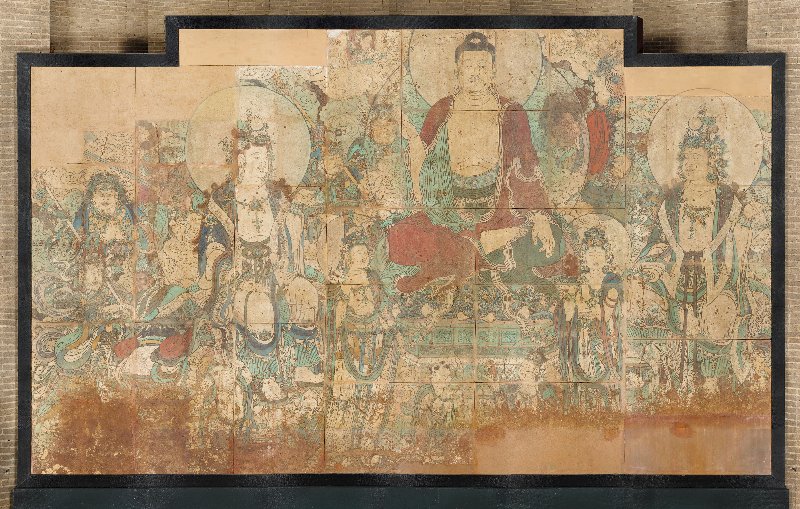
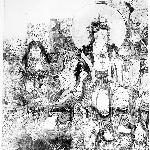
Mural painting from temple wall. Complete wall, total of 23 sections. The central figure in this mural is Bhaisajyaguru, the Healing or Medicine Buddha. He is associated with longevity and guards against untimely death, nightmares, evil apparitions, vicious animals, robbers, thieves, and invading states. The Bodhisattvas of the Moon and Sun, identified by the aureoles or circular lights around their heads, form a triad with the Buddha.
Bhaisajyaguru is also accompanied by the Twelve Guardian Generals who represent the Buddha's twelve vows. The Generals make offerings to the Buddha so he will grant their wishes and free them from suffering. They have pledged to protect those who inform others about Bhaisajyaguru.
Worshippers turned to this image to try and visualize themselves in paradise, a beautiful place with jeweled trees, palaces, lotus ponds, musicians, and dancers. Some believed that worshippers could be reborn in paradise by simply reciting the name of Buddha Amitabha rather then through meditation and austerities.
Jing, Anning. The Water God's Temple of the Guangsheng Monastery: Cosmic Function of Art, Ritual, & Theater. Leiden: E. J. Brill, 2002. See: Pg. 211-212, Fig. 4-18
Seymann, Michelle B. "Monumental Wall Paintings of the Assembly of the Buddha from Shanxi Province: Historiography, Iconography, Three Styles, and a New Chronology." Artibus Asiae 54, no. 3/4. (1994): 241-267.
Steinhardt, Nancy S. "Zhu Haogu Reconsidered: A New Date for the Rom Painting and the Southern Shanxi Buddhist-Daoist Style." Artibus Asiae XLVIII, 1/2. (1987).
Miller, J. L. "Ancient Chinese Wall Paintings: Recently Brought to This Country by the University of Pennsylvania Museum." The Mentor 16, no. 3 (April). (1928): 41-44. Page/Fig./Plate: 43-44
Yetts, Walter P. "Some Buddhist Frescoes from China." The Burlington Magazine for Connoisseurs 51, No. 294. (1927). Page/Fig./Plate: 121-128, Plates I, II